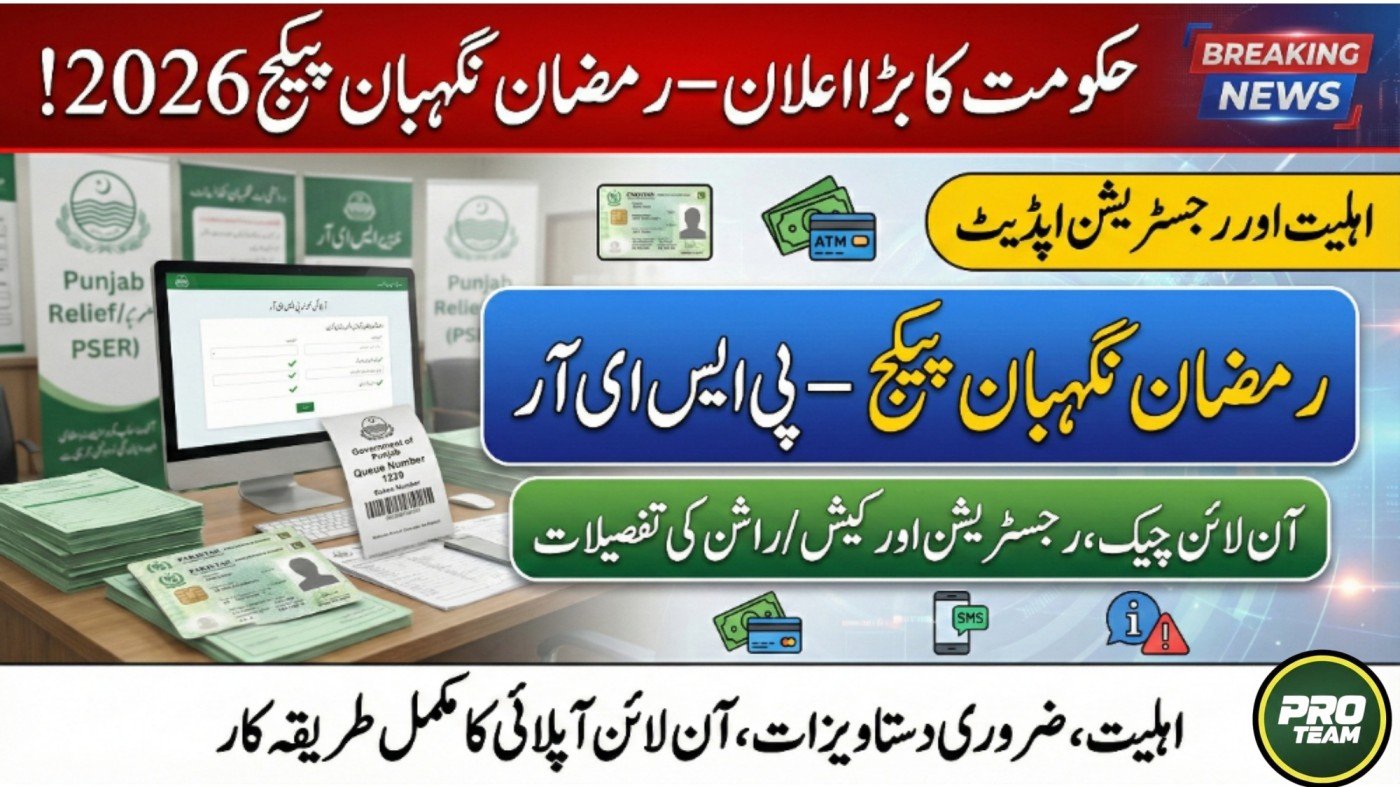
The Punjab Ramadan Nigehban Package 2026 is a special relief program launched by the Punjab Government to help poor and low‑income families during the holy month of Ramadan. The government offers cash or ration support so that eligible households can buy food and essentials without financial stress. The eligibility rules are set to make sure that help reaches the right families quickly and fairly.
Below is a clear table showing the main eligibility requirements and support details for the Ramadan Nigehban Package 2026.
| Eligibility Factor | Details |
|---|---|
| Province | Must be a resident of Punjab |
| CNIC | Valid Pakistani CNIC required |
| Income Level | Low‑income household |
| Poverty Score | Low Poverty Means Test (PMT) score |
| Database | Registered in PSER or BISP |
| Mobile Number | Active number linked to CNIC |
| Job Status | No Grade‑17 or above government job |
| Official Portal | https://pser.punjab.gov.pk |
Who Is Eligible for Ramadan Nigehban Package 2026?
Understanding the eligibility criteria helps families know if they can receive support. The government selects beneficiaries through data it already has in official systems.
- Families living below the poverty line
- Households registered in the Punjab Social and Economic Registry (PSER)
- Families already in BISP or Ehsaas welfare programs
- Daily wage earners and labourer households
- Women‑headed households with low income
These groups are chosen because they have limited financial resources and face difficulty buying food or essentials during Ramadan.
Why CNIC and Residency Are Important for Eligibility
To be included in the Punjab Ramadan Nigehban Package 2026, you must prove your identity and where you live. This helps the government confirm that assistance goes to the right family.
- A valid CNIC shows official identity
- An active mobile number linked to CNIC receives updates
- Punjab residency confirms the family belongs to the right region
- Household members must be listed correctly in official records
Accurate CNIC and address details are essential to avoid errors or rejection of support.
How Poverty Means Test (PMT) Affects Eligibility
The Poverty Means Test (PMT) is a key part of deciding who qualifies for the Ramadan Nigehban Package 2026. It measures how poor a household is, based on official data.
- Low PMT score means the family is poorer
- Families with lower scores get higher priority
- Higher scores may reduce eligibility chances
- PMT helps the government target deserving households
Families with good data in PSER and BISP are more likely to have the right PMT score for eligibility.
Which Families Get Priority in the Nigehban Package?
The Punjab Government gives priority to the most vulnerable people to ensure fair distribution of support during Ramadan.
- Widows and women‑headed households
- Households with disabled members
- Elderly citizens without stable income
- Large families with many dependents
- Daily wage workers with unstable income
These priority groups are more likely to receive support early because they need it most.
Who Is Not Eligible for the Ramadan Nigehban Package 2026?
Not all households can receive this support. Some conditions may make a family ineligible, even if they apply.
- Household income is above the official limit
- Family owns major assets like commercial property or luxury vehicles
- A family member holds a Grade‑17 or above government job
- Household has a high PMT score showing better financial status
These criteria help ensure that assistance is reserved for the most needy families.

Required Documents for Ramadan Nigehban Package 2026
To verify eligibility for the Ramadan Nigehban Package 2026, families may need a few important documents. Having these documents ready helps speed up verification and avoid delays.
- Original CNIC of the head of household
- CNIC or B‑Form of other family members
- Active mobile number linked to CNIC
- Updated data in PSER or BISP systems
If your family data is already in PSER or BISP, you may not need to attach extra documents when checking eligibility.
How to Check Your Eligibility and Contact Helpline
You can confirm your eligibility and status using official government systems.
- Online Portal: Visit https://pser.punjab.gov.pk and use the status check feature
- SMS Check: Send your 13‑digit CNIC to the official number shared by government communications
- Local Support: Visit your nearest Union Council office for help with verification
Official helplines and portals are provided to ensure that beneficiaries receive accurate information and avoid fake agents or scams.
Conclusion
The Punjab Ramadan Nigehban Package 2026 eligibility criteria are set to support poor and vulnerable families in Punjab during Ramadan. Eligibility depends on being a resident of Punjab, having a valid CNIC, and a low Poverty Means Test (PMT) score. Priority is given to widows, elderly citizens, disabled households, daily wage workers, and large families. Keeping your official records updated ensures smooth verification and timely receipt of support.
FAQS:
1. Who is eligible for the Ramadan Nigehban Package 2026?
Low‑income families with valid CNIC and low PMT score registered in PSER or BISP are eligible.
2. Do I need PSER registration to apply?
Yes, PSER registration helps confirm eligibility and may allow automatic inclusion.
3. Can families with government jobs receive this support?
Families with Grade‑17 or above government employees are usually not eligible.
4. How do I check my eligibility status?
Check online at https://pser.punjab.gov.pk or via SMS using your 13‑digit CNIC number.
This article is for informational purposes only. SmartFixers.pk is not an official government website and is not affiliated with any government department. Readers are advised to verify all information from official government sources before taking any action.
Our editorial team publishes original and informational content for educational purposes only.
Related Posts